
You already know what good coaching looks like. Now you have a second pair of eyes.
Good coaches notice everything. But no one can remember everything.
You're holding context for every client — their goals, their language, their patterns, the commitments they made three sessions ago and whether they followed through. The more clients you coach, the harder it gets to walk into each session fully prepared. Not because you're not paying attention. Because there's simply too much to hold.
The AI Thinking Partner doesn't replace your judgement. It gives you a memory that doesn't fade and a perspective that spans every session, note, and reflection in your workspace. Ask what's changed since the last conversation. Ask what themes keep repeating. It draws from your client's actual journey — their timeline, their documents, their words — and reasons through the coaching frameworks you've chosen. Not generic advice. Your methodology, applied to their data.
Think of it as the preparation you'd do if you had unlimited time — available in the moments before a session begins.
Walk into every conversation knowing what matters.
Session preparation shouldn't mean scanning through old notes hoping something jumps out. The AI Thinking Partner brings the important context forward, so you can focus on being present.
Know where they are before you ask
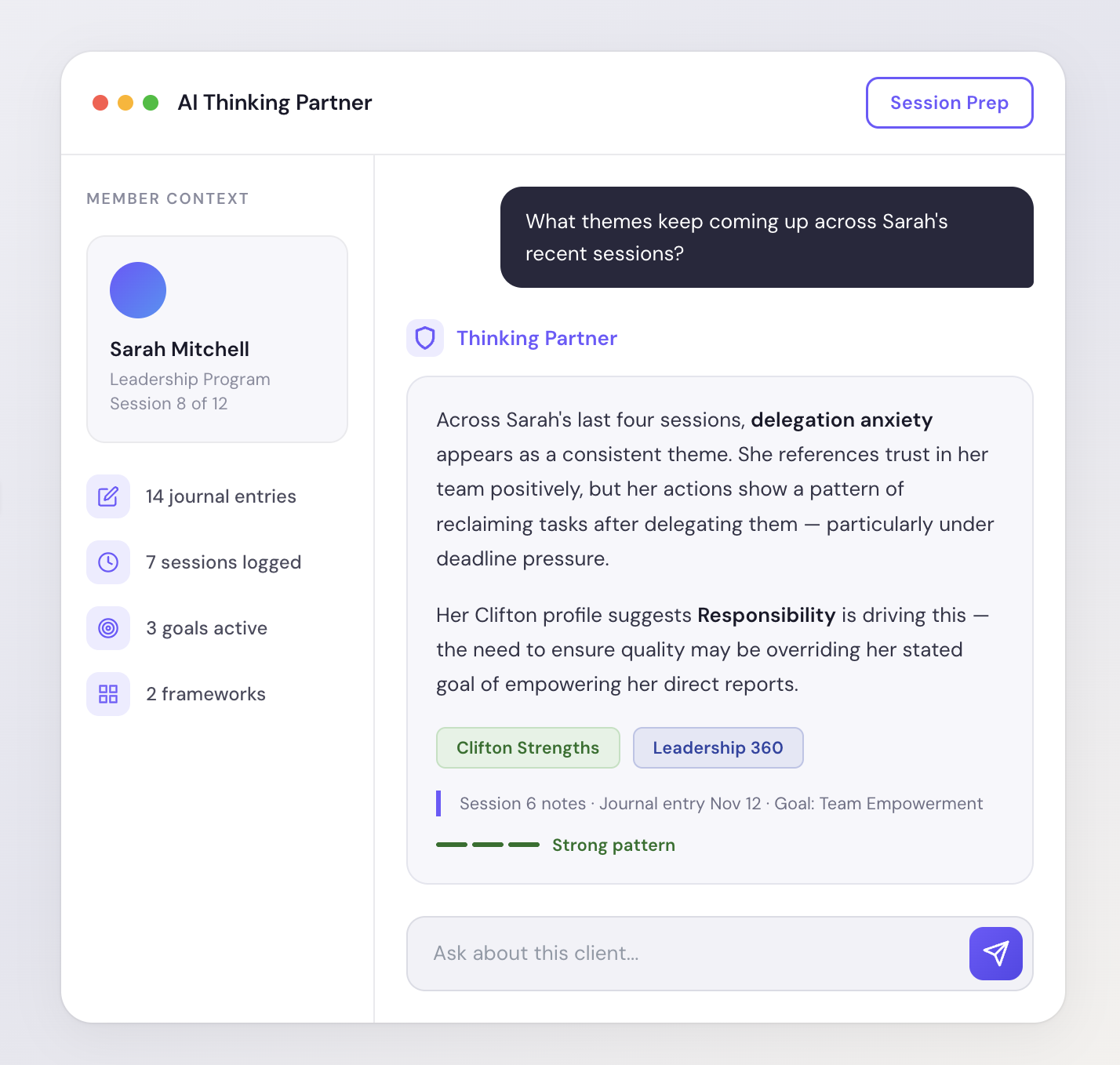
You're about to start a session. Instead of scrolling through weeks of notes, you ask: "What's changed since we last spoke?" The AI draws from your client's timeline — session notes, journal reflections, completed exercises — and surfaces what's shifted. You see real engagement, not just a list of activities. The conversation starts further along because you already know where they've been.
See whether progress is real or surface-level
A client says they're doing well. But are they? The AI can look across sessions and compare commitments against actions, patterns against stated goals. It references specific moments — what they wrote in a reflection, what came up in a previous conversation — so you can ask better questions. Not because you're checking up on them, but because you see the full picture.
Spot what's forming before it becomes a pattern
Sometimes the most important insight isn't in any single session — it's in the space between them. The AI connects observations across weeks and months, noticing when language shifts, when energy drops, or when a theme keeps surfacing in different forms. It tells you how confident it is in what it sees, so you can decide what to explore. You're not reacting to one data point. You're reading the arc.
AI that thinks through your methodology — not around it.
Most AI tools bring their own perspective. The Thinking Partner brings yours. It reasons through the coaching frameworks you've chosen, so every insight reflects the way you actually work.
Your frameworks shape every insight
If your program uses Clifton Strengths and CBT, the AI analyses your client's data through both lenses. If you're running a leadership program with a custom methodology, it uses that. Each coaching Collection carries its own instructions that teach the AI how to reason within that framework — what to look for, what language to use, what to avoid. The insights it surfaces aren't generic. They're grounded in the specific approaches you've built your practice around.
Layer context for each program
Different programs need different perspectives. A strengths-based executive coaching program and a wellbeing program for early-career professionals require different tones, different focus areas, and different kinds of insight. Program-level instructions let you add that context — who the participants are, what matters most, how direct or reflective the AI should be. The frameworks define how it thinks. The program defines where it focuses.
Multiple lenses, one conversation
Coaching rarely fits into a single framework. When you assign multiple Collections to a program, the AI reasons across all of them simultaneously. It might notice a strength being overused through a Clifton lens while identifying a cognitive pattern through CBT. You can even set priorities — leading with one framework and drawing on others when relevant. The AI follows your guidance, not its
Every insight comes with a source. Every uncertainty is named.
AI is only useful in coaching if you can trust what it tells you. The Thinking Partner is built on a simple principle: you should always know what it knows, where it got it, and how confident it is.
Nothing is made up
The AI only draws from data inside your workspace — program blueprints, Collection content, session notes, journal entries, client documents, and timeline interactions. It doesn't search the internet. It doesn't fill gaps with generic knowledge. If it doesn't have enough information to answer a question, it says so. In coaching, credibility matters more than confidence — and the Thinking Partner is built to reflect that.
Know how strongly it sees something
Not every pattern is equally clear, and the AI doesn't pretend otherwise. It expresses confidence in plain language — strong when a theme appears across multiple sessions and aligns with your frameworks, moderate when the data is limited but the connection is reasonable, speculative when something is emerging but unclear. You always know whether you're looking at a well-supported observation or an early signal worth watching.
Your thinking space, not your client's
Everything the AI produces is for you — the coach. Your clients never see it, never interact with it, and never know it's there unless you choose to tell them. It's a preparation and reflection tool, not a coaching intervention. You decide what to act on, what to explore in conversation, and what to set aside. The AI supports your thinking. The coaching stays yours.
See how the AI Thinking Partner fits your coaching practice.
Book a short demo to see the Thinking Partner in action — how it prepares you for sessions, surfaces patterns across client journeys, and reasons through your own coaching frameworks.